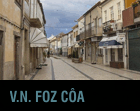
Castelo de Vide

On a hill side facing to East and adjoining to the old medieval part develops the Jewish quarter from Castelo de Vide.
In a steep slope meander the narrow sidewalks which go from “Porta da Vila”, in the Castle, to “Fonte da Vila”, in everything equal from those who form the remaining medieval nucleus. It’s interesting to verify that the Jewish community from Castelo de Vide grew between two fundamental spaces – the old Market Square and the obsolete “Fonte da Vila”.
The Jew, for its experience in the Diaspora, is fundamentally linked to market activities, justifying, mutually market and Jewry, in the same place – eastern slope of the Castle.
Although the hard urban delimitation, the Jewry from Castelo de Vide grew, fundamentally, from the streets “Fonte”, “Mercado”, “Arçário”, “Mestre Jorge”, “Judiaria”, “Ruinha da Judiaria”, the current “Rua dos Serralheiros” and “Rua Nova”. The extend of this space can be understood because of the proximity to the Castilian border.
The edict from 1492, promulgated by the Catholic Kings, Fernando and Isabel, caused a massive displacement of Jewish families seeking, on this side of the border, the peace that the prophecies denied them in a strange land. Date from that time the commercial and manufacturing development that came to characterize, later, Castelo de Vide.
Not only in arts and crafts became known the Jewish community in Castelo de Vide, but also in botany and medicine, as prove us the names of “Garcia de Orta” and “Mestre Jorge” – the physician.
Regarding the renewal that, through its continued occupation, was suffering, the Jewry from Castelo de Vide shows some characteristics elements: ogival doors from housing and market (some decorated with professional symbols), the old sidewalks and the building that is thought to be the ancient synagogue.
This building identified as the Medieval Synagogue it’s located between “Rua da Judiaria” and “Rua da Fonte”. It has two floors, opening up in one of the divisions of the upper floor what is thought to be the Tabernacle (Sanctuary).
In this room would gather men in the community, while in the division on its right, separated by a tiny peephole, gathered the female people, during the studies of Sacred Texts. The synagogues as a space of multiple facets worked, at the same time, as a School.
Also in Castelo de Vide’s synagogue there’s a space, said in popular tradition that could have been dedicated to teaching young children. The School was located on the left of the Tabernacle room.
The restoration, consolidation and enhancement of the synagogue forced to carry out several archaeological surveys on the ground floor. On those works, besides identifying the various testimonies of the different occupations over time, was possible to maintain three silos excavated in the base granite, one of them showing traces of having been lined with cork boards.
The different stratigraphic levels observed indicate the existence of, at least, three distinct phases of ground floor use. The oldest, contemporary silo opening goes back to the end of the century. The two silos from the first room have been in use until the mid-sixteenth century, while the materials unearthed in the second compartment point to a later exit.
Whether by archaeological materials collected inside the silos, either by the estate identified in the survey carried out in the yard of the synagogue, once covered space, we can affirm that the 16th century was a time of profound changes on this building, same time of the end of Jews freedom worship in Portugal. This building has had other uses later. The inner and outer space was being changed and adapted over the centuries. The Tabernacle was only rediscovered in the seventies of this century, when they proceeded to the arrangement of the walls.
No one knows the date of its foundation, however, already in the fourteenth century there was a Jewish quarter in Castelo de Vide, composed of a number of houses built near the front door of the Castle. The synagogue is located in “Rua da Judiaria” /”Rua da Fonte” and the building is oriented towards the East/West. The entire set consists of a single volume with two floors. The synagogue is named “BEIT-HA-MIDRASCH-SEFARDIN”. In the enclosure to worship, have the tabernacle, with the respective cavities for “Holy Oils” lamps and on the right of this part, one would support the holy scriptures, where, at the base, are located seven balls related to the six days during which God create the world and the last day, the seventh, rest of the work. In 18th century suffered adaptation works for residence. It was rebuilt respecting the primitive moth in 1972. A gate to the first floor has a small cavity called MEZUZAH, Hebrew word meaning “door jamb”.
This concavity was intended to keep a kit containing a small parchment on which were written some words from SHEMA, fundamental prayer of Jewish worship. All doors are in warhead with sharp edges. Laws enacted by some Lusitanian monarchs in order to create their own ghettos, where Jews lived alone, led to the appearance of neighborhoods, also known by the name of “Jewish quarters”.
In the 14th century, D. Pedro I apart from the Master Pedro Lourenço, probably Jew, a land in Castelo de Vide, as shown in several documents dated from the fourteenth century that testify the existence of the Jewish community in the village.
In Castelo de Vide, the Jewish quarter developed on the slope facing the East. Although established in one of the most rugged areas, the district was traversed by a central axis of communication with the outside of the castle and vice versa.
From the Jewish presence in Castelo de Vide left some material evidence with special importance the building where the medieval synagogue must have worked. Other buildings from “Rua da Judiaria”, “Rua da Fonte” or “Ruinha da Judiaria” also show what remains of the ancient Jewish tradition of marking their faith in the door jambs.
The establishment of the Inquisition and the publication of the Jews Expulsion Edict of the Spain kingdoms, by Fernando and Isabel, the Catholic kings, contributed to the growth of Castelo de Vide’s Jewry which maintains in the toponymy of its streets the testimony of Jewish presence, but also the persecution of the Holy Office to New Christians.
Image Gallery


http://www.redejudiariasportugal.com/index.php/en/cidades/castelo-de-vide#sigProGalleriae5e0c174bf